Review · LP · 1964
The Genius of Out To Lunch!
Eric Dolphy is at once one of the most diverse, innovative, and influential jazzmen of all time — and one of the most misunderstood and neglected. In this review of Out To Lunch!, Jason Elwood attempts to demystify what makes Eric Dolphy so beloved, despite being an enigma to so many.
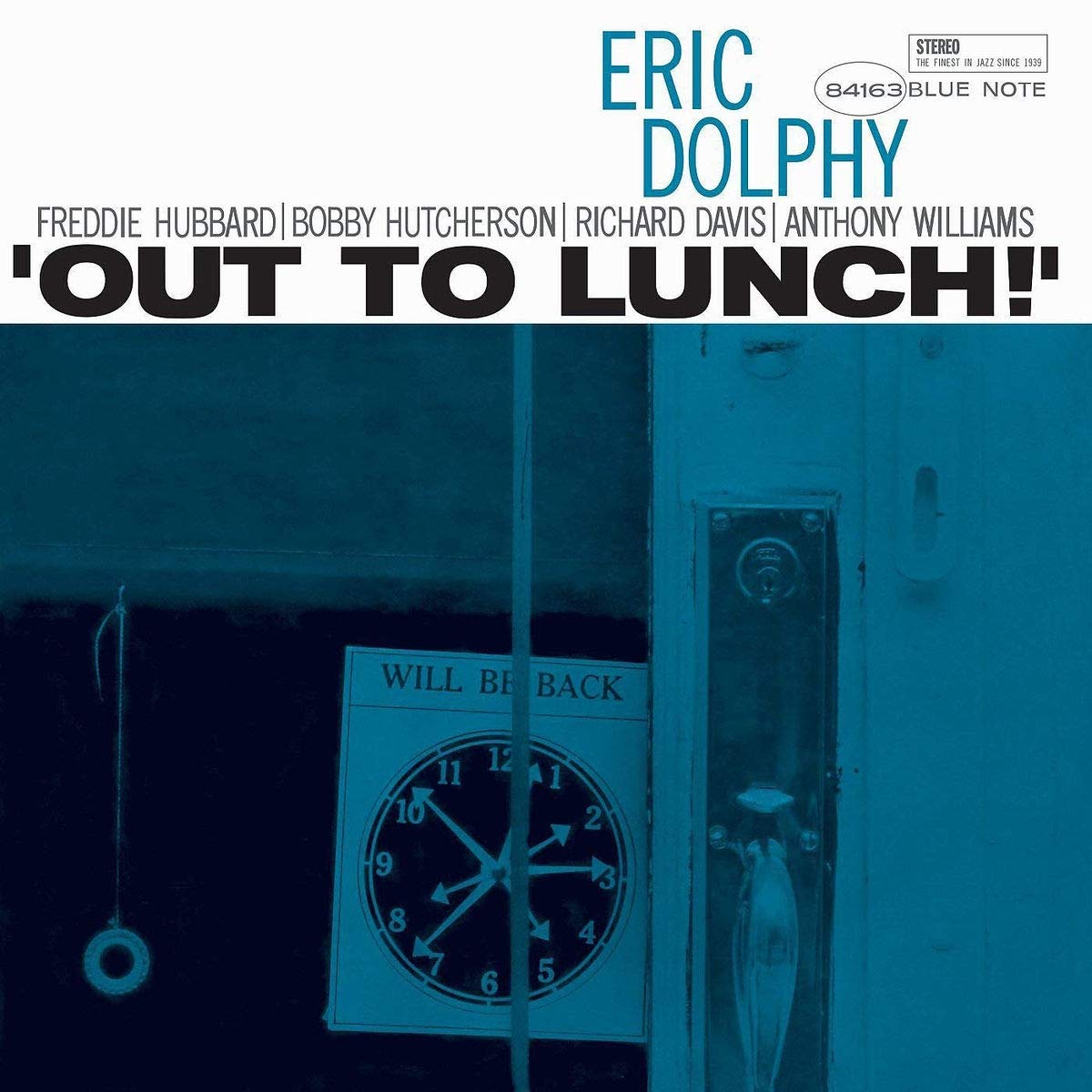
Out to Lunch! — Eric Dolphy Blue Note, 1964. Recorded February 25, 1964, Van Gelder Studio, Englewood Cliffs.
Eric Dolphy is at once one of the most diverse, innovative, and influential jazzmen of all time — and one of the most misunderstood and neglected.
My affinity is obvious: his poster hangs on the wall behind me. But for many people, Dolphy’s music stays elusive. You know he looks cool, his records look cool, you know you are supposed to appreciate his place in jazz history — and still, truly hearing him can feel like work. This review is an attempt to close the gap between curiosity and real appreciation, and there is no better place to start than Out to Lunch.
Out to Lunch is one of the most iconic albums in jazz history, and it is Dolphy’s one and only Blue Note release as a leader. It was recorded on February 25, 1964, at Van Gelder Studio in Englewood Cliffs, and released in August of that year — two months after Dolphy’s death in Berlin at thirty-six. He did not live to see it reach the jazz masses: the record that changed the course of jazz, and the fullest demonstration of his development as a composer and player. All five compositions are his, and Dolphy wanted it understood that everyone on the session was a leader.
Just look at the lineup. Freddie Hubbard on trumpet, Bobby Hutcherson on vibes, Richard Davis on bass, and eighteen-year-old Tony Williams on drums — and Dolphy himself on alto saxophone, bass clarinet, and flute, pulling out all the stops. There is no piano on this record, and that is one of its defining decisions. Dolphy was excited to work with Hutcherson again, and the reason is in the sound: where a piano can seem to control a session, the vibes open it up. In essence, Hutcherson’s playing is not a feature of this album; it is a condition of it. Without Bobby Hutcherson, there is no Out to Lunch.
That is another thing about Dolphy’s playing that doesn’t get talked about enough, especially here: the acoustic ambience these five musicians create together. From the first second, you know you are going to hear something special.
Hat and Beard opens the record — a nod to Thelonious Monk, with Dolphy on bass clarinet. From Hutcherson’s vibes to Hubbard’s trumpet, Davis’s bass, and Williams’s drums, each instrument is a vibrant part of the composition, played meticulously. Point to any part of this track, any instrument, and it sounds innovative and fresh and necessary. Inevitable, in the word this record keeps teaching you: it has to be there.
Something Sweet, Something Tender is the second and last time we hear the bass clarinet, and it is a slow track, the kind you might hear in an old 1950s jazz soundtrack, with something of Charles Mingus in its feeling. It sounds almost blasphemous to single anyone out on a record where every note is inevitable — but here it is the bass clarinet and vibraphone interplay that creates an atmosphere out of this world, Hutcherson’s playing almost like a lullaby, until we wake up just in time for the next track.
Gazzelloni is the album’s flute feature, and every musician is in top form, each molding the composition like clay. Dolphy’s playing feels improvisational, experimenting, having fun with phrasing — and this record holds some of my favorite playing anywhere by Freddie Hubbard, who buys completely into the playground Dolphy built and lets himself loose in it. Hutcherson is spectacular here, Davis’s bass harmonics are otherworldly, and Williams is, simply, amazing.
A critic once summed up Dolphy’s style in three words: fragmentation, decoration, and a very direct emotionalism. The first two are fair. The trouble starts with the word that usually gets smuggled in beside them — random. The careful listener will object to “random,” and to any implication that Dolphy’s solos are not logical, because that is exactly the misreading that has kept his music misunderstood. Dolphy said it himself, in 1960: he thought of his playing as tonal. He played notes that would not ordinarily be called in a given key, but he heard them as proper, and he did not believe he left the changes — every note he played had some reference to the chords of the piece. There it is, from the man himself. What sounds fragmented is, on closer listening, as logical and coherent as his phrasing.
Then comes the twelve-minute title track, and I don’t know what to compare it to. Dolphy is on alto now, spinning some of his best saxophone playing on the record, while Hutcherson complements the space with a note here and a note there, emphasizing the harmonies sparsely. Each of the five seems to be in his own world — and yet they share something like a telepathic connection. It is literally as if five of the greatest musicians to ever walk the earth locked themselves in a studio and started doing what they do best: having fun, exploring, seeing what happens.
The final track, Straight Up and Down, is another experimental piece, built on odd time signatures, and it reminds me of what Frank Zappa would do later in the decade — Zappa even titled a track the Eric Dolphy Memorial Barbecue, and he must have been a fan. Dolphy’s alto here is almost begging for mercy while Williams’s drums seem to antagonize him, and Hubbard and Hutcherson engage in an improvisational dance of their own, like a sonic interpretation of a theatrical dance. However you interpret it, the results are spectacular.
The album ends far too soon, and leaves you wishing there were a sequel. Instead you flip the record and start all over. For me, this record brings the kind of joy you usually reserve for Christmas morning, a first kiss, the best pizza you’ve ever had. The best statement you can make about it is the simplest: listen to it, love it, sit with it if you need to, flip it over, and listen to it again. It is a masterpiece.
What might first sound random and fragmented reveals itself, on repeated listening, as logical and coherent as his phrasing — delivered with an enthusiasm and passion that are nearly overwhelming, and an ease through the most intricate technical passages that makes the whole thing feel inevitable. And on those infrequent moments when he doesn’t quite land an astronomically high note, or stumbles, the imperfections remind you that Dolphy is, after all, human. Therein lies the beauty of Eric Dolphy the musician and Eric Dolphy the person. Elvin Jones remembered him as conscientious, almost meticulous, and brimming over with ideas — so many, in fact, that having too much to say occasionally got in the way of his saying it. I’ll take authenticity, enthusiasm, and passion over perfection any day of the week.
Dolphy himself put it best when he talked about playing free: he liked to be in the group where he was as free as possible, playing all kinds of ways, broadening himself by playing with as many musicians as he could. Because music, whatever label you put on it, is basically creative — and once it’s over, it’s gone in the air. You can never capture it again. It is pure creation, whether you’re listening to Beethoven or Mingus or Coltrane. That is what this record is: five musicians, free, creating something that can never happen the same way twice. Flip it over and listen again. Watch the video version on YouTube: